Why NOW and COMP Waivers Matter for Georgia Families
March is Developmental Disabilities Awareness Month, a national campaign that began in 1987. It reminds us that people with intellectual and developmental disabilities (I/DD) are important members of our communities and should be fully included in all parts of life—school, work, recreation, and community activities.
In this article, you will read about a young woman with I/DD who is living the life she chooses. She is building an independent and meaningful life with support from her family and the services provided by a Medicaid waiver.
Mia Nobbie is a person with I/DD who leads an active and independent life in Athens, Georgia. She is involved in her community, works four days a week, bowls twice a week, and helps with a Sunday school class at her church. Her success is possible because of the strong support from her parents and siblings. Another important part of her journey has been the Medicaid waivers she receives, which help her get the services and support she needs.
The New Option Waiver Program (NOW) and Comprehensive Support Waiver Program (COMP) are two vital home- and community-based services (HCBS) programs administered by the Georgia Department of Behavioral Health and Developmental Disabilities (DBHDD). NOW and COMP pay for services for eligible people with I/DD that support them to receive care in their home. The funding support also opens doors to new and exciting opportunities to engage with their communities and live independently.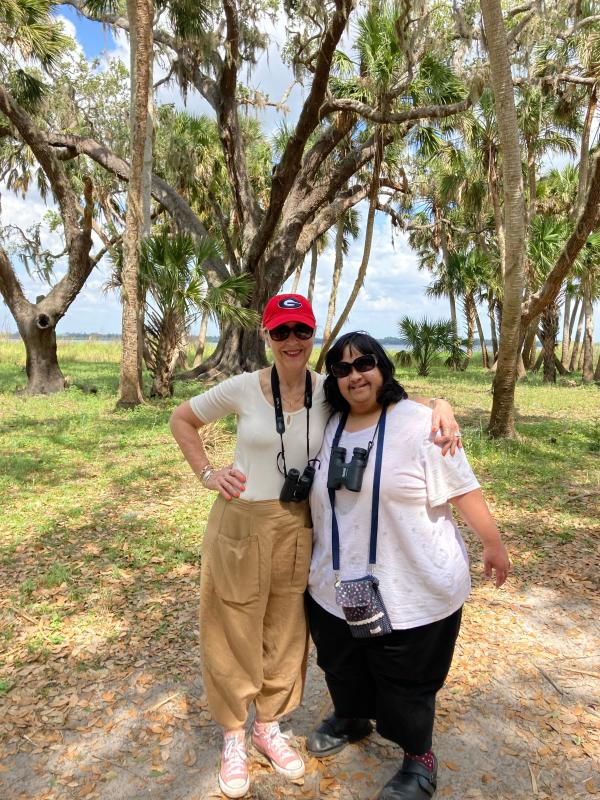 Pat and Mia Nobbie
According to Mia’s mother, Pat Nobbie, caring for Mia Nobbie was a team effort and often challenging before her daughter received the waiver. The family sometimes had to pay out of pocket for people to help take her places and spend time with her.
“I was commuting daily from Athens to Atlanta, though fortunately, my boss was very accommodating,” said Pat Nobbie. “My husband worked in Athens, and Mia had two younger siblings in high school. Between all of us, we were able to manage her days. However, Mia was very clear about her own goals: she wanted to work and have her own place to live.”
Mia Nobbie participated in a job-prep program in high school, but she had no job prospects when she graduated. Services funded by her COMP waiver connected her with Briggs & Associates, a Georgia-based supported employment agency that helps individuals with I/DD find meaningful employment and provides support and training.
“Having good direct support staff and job coaching is essential,” explained Pat Nobbie. “Briggs & Associates has supported Mia Nobbie for two decades. She needs very little support now, but they still see her every week. Her direct support staff has been stable for decades, which is unusual.”
For many Georgians, it is not easy to get support through the NOW and COMP waivers. According to the Georgia Budget and Policy Institute, 4,505 people are enrolled in the NOW waiver and 9,789 are enrolled in the COMP waiver. At the same time, 7,891 people are still on the DBHDD waiting list. These numbers show that many people are still waiting for the services and support they need.
“What I want policymakers to understand is that when people have support, they can contribute to the social and economic life of their communities, and their families can continue their contributions as well,” says Pat Nobbie. “I figured out that Mia returns more than half of the cost of her waiver to the local and state economy. She earns enough at her job to pay market rent for her apartment. Her waiver employs two direct support staff, a job coach, and a Support Coordinator. All those employees, including Mia, pay taxes. She pays for groceries, attends social events, buys her own clothes, birthday presents, thereby contributing to the Athens economy.” (See GCDD’s ROI of NOW/COMP Waivers Fact Sheet, featuring Mia Nobbie)
Advocates like Pat and Mia Nobbie are strong voices pushing to expand access to NOW and COMP waivers in Georgia. Lawmakers often say there is not enough money in the budget to provide more services. However, Pat Nobbie believes the state has enough funding to better meet the needs of Georgians with disabilities.
“We need families to speak up. As long as families are taking care of their loved ones with disabilities as best they can, legislators figure the need is not pressing. Talk to them,” encourages Pat Nobbie. “The state has a $10 billion surplus and providing the number of waivers that DBHDD worked out (1,217) would cost $132 million. Enough is enough. People want to be involved in their communities. They want to work and worship and participate and contribute. It’s time to fund this support.”